

What Pride Bank’s 2025 Performance Reveals About the Next Phase of Growth

Pride Bank’s 2025 performance signals more than strong financial growth; it reflects disciplined execution, deepening customer trust, and a maturing institution positioned for sustainable scale. From stronger profitability to expanding inclusion, the Bank is translating its Tier II transition into measurable impact while building resilience, operational efficiency, and long-term value across Uganda’s economy.
By Irene Mwoyogwona
When Pride Bank transitioned to a Tier II Credit Institution in November 2024 under the supervision of the Bank of Uganda, the question was not whether we would grow, but how sustainably and how effectively that transition would translate into real performance.
Our 2025 results provide a clear answer. This has been a year of traction, where structural shifts within the institution have begun to convert into measurable financial outcomes, and a year that reinforces the principle that disciplined growth, when anchored in purpose, compounds over time.
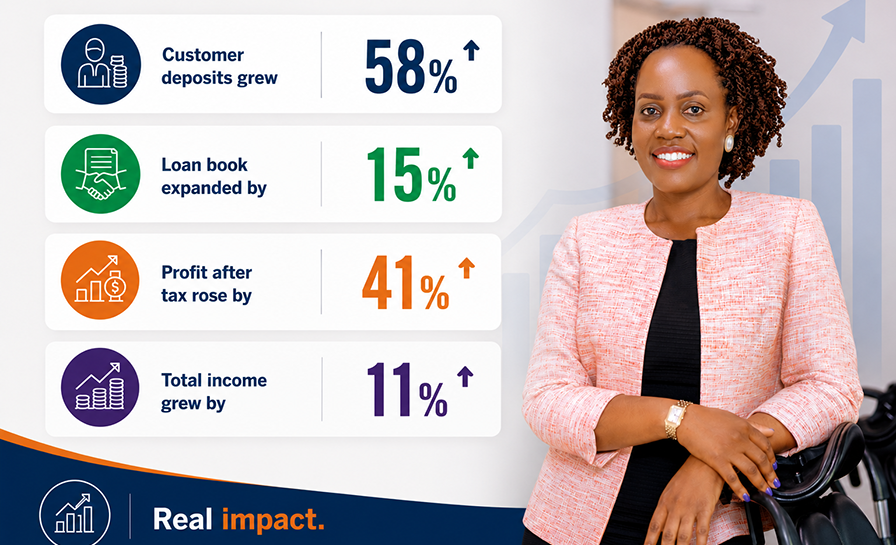
At a headline level, the numbers are strong. Customer deposits grew by 58% to UGX 282 billion, our loan book expanded by 15% to UGX 268 billion, total assets increased by 28% to UGX 574 billion, and profit after tax rose by 41% to UGX 11.6 billion.
However, the real story lies not in the scale of growth, but in its quality. Deposit growth at this level reflects deepening customer trust and confidence in the institution, particularly in a market where choice is increasing.
At the same time, our more measured expansion of the loan book signals a deliberate and disciplined approach to risk.
In a newly elevated Tier II environment, rapid lending can be tempting, but sustainable growth demands a more balanced approach.
This discipline is further reflected in our earnings profile. Total income grew by 11%, driven primarily by net interest income, underscoring the strength of our core lending model.
At the same time, expenses increased by 6%, a slower pace that points to improving operational efficiency even as we continued to invest in our people, systems, and infrastructure.
Perhaps most notably, we recorded a significant turnaround in credit performance, moving from a UGX 7.5 billion impairment charge in 2024 to a net credit position in 2025.
This shift reflects stronger recoveries, tighter credit monitoring, and a maturing risk management framework. As a result, our profitability growth is robust and structurally sound.
As we scale, maintaining balance remains critical. Our capital adequacy ratios, 49.7% for core capital and 50.4% for total capital, remain well above regulatory requirements, providing a strong buffer to support continued expansion.
While non-performing loans increased modestly, improved recoveries and lower write-offs indicate that asset quality is stabilizing rather than deteriorating.
This balance between growth and prudence is intentional, grounded in the understanding that sustainable performance is built on resilience.
Our performance must equally be viewed through the lens of the real economy. Our lending continues to be directed toward micro, small, and medium enterprises, agriculture, and the informal sector, segments that remain underserved by traditional banking models.
In 2025, we served over 83,000 borrowers, including more than 15,000 in agriculture, over 37,000 women, and nearly 23,000 youth.
Most importantly, behind every number there is a real impact: a life transformed somewhere, enterprises sustained, and opportunities created.
On the funding side, our depositor base grew to over 327,000 customers, reinforcing a financial ecosystem where savings mobilization and credit extension work together to drive inclusion.
It is important to recognize that 2025 is not an isolated year, but part of a longer trajectory under the leadership of Managing Director Veronicah Namagembe.
Over the past 16 years, Pride Bank has grown its deposits more than twentyfold and expanded its loan book nearly sixfold, all while maintaining consistent profitability, even through periods of economic disruption.
The Tier II transition represents not a starting point, but a milestone within this broader journey. What we are now seeing is the compounding effect of long-term institutional discipline translating into accelerated performance.
The focus now shifts from transition to execution at scale. A stronger deposit base and solid capital buffers position us well to deepen lending in key sectors such as agriculture, trade, and SMEs, while also advancing our ambition to become a digital-first institution.
At the same time, we remain clear-eyed about the need to maintain asset quality, manage costs, and sustain profitability as we grow.
2025 is the year Pride Bank moved from transition to traction. The foundations have been built over time, the regulatory milestone has been achieved, and the early results are now evident.
The responsibility ahead is to sustain this momentum; deliberately, responsibly, at a notable scale, and that is exactly what we intend to do.




 Let's Talk